
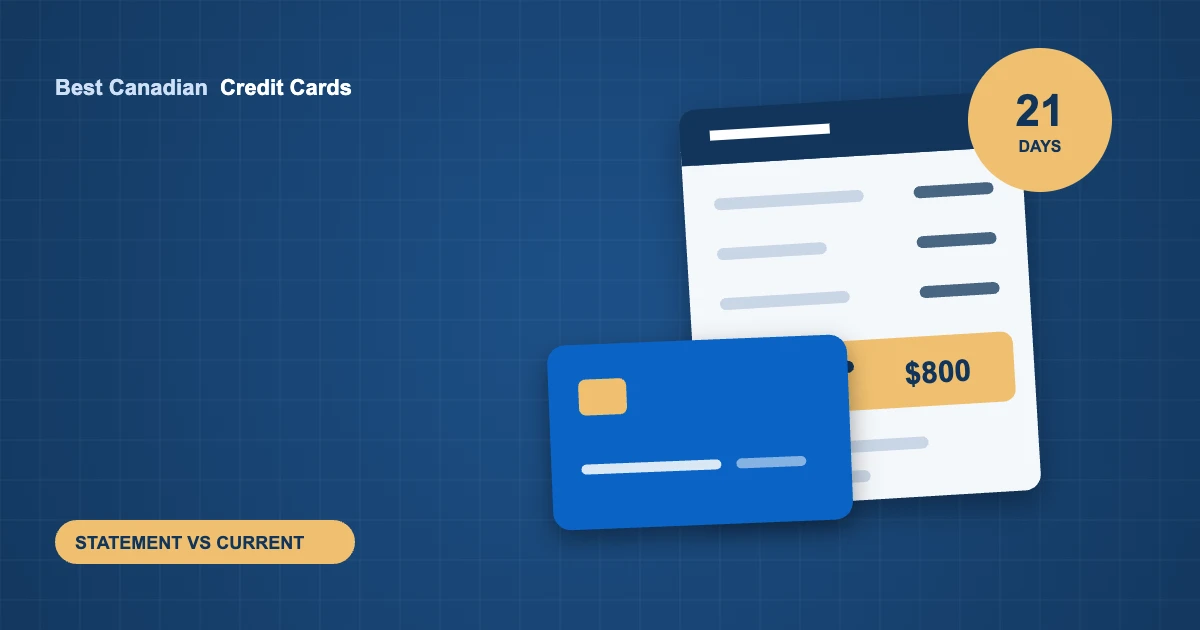
Your credit card app shows two balances, and they rarely match. The statement balance is what you owed on the day your last statement closed. The current balance is what you owe right now, including anything you bought since. Here’s what each one means, which one to pay, and what happens if you pay too little or too much.
The numbers on your credit card bill
| Number | What it means | Does it change? |
|---|---|---|
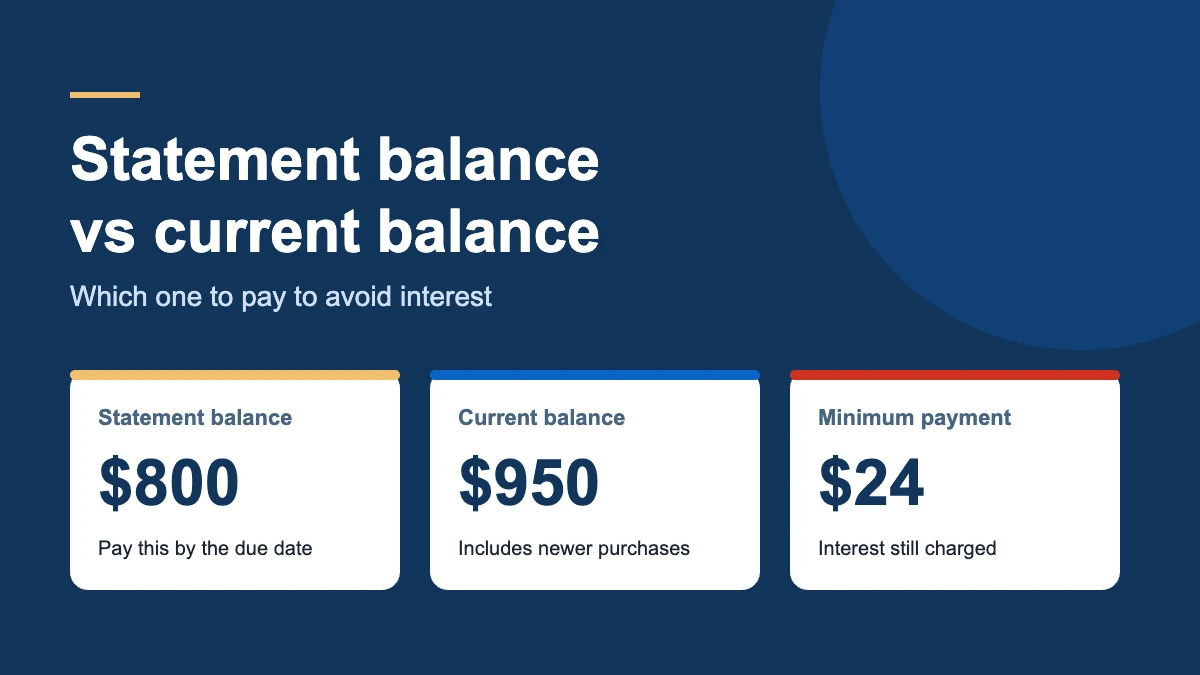
| Statement balance | What you owed when your last statement period ended. CIBC, for example, calls it the total balance. | No. It stays the same until your next statement. |
| Current balance | What you owe right now: the statement balance, plus new purchases, minus payments and refunds since. | Yes. It moves every time a transaction posts. |
| Minimum payment | The smallest amount you must pay by the due date to keep your account in good standing. | No. It’s set on your statement. |
| Payment due date | The last day to pay. At banks, it’s at least 21 days after your statement period ends. | No. It’s set on your statement. |
Your statement period (also called the billing period) is usually about a month. The last day of it is your statement date. Everything that posts after that date shows up on your next statement, not this one.
Which one to pay to avoid interest
Canadian banks and other federally regulated card issuers must give you an interest-free grace period of at least 21 days on new purchases. It starts on the last day of your statement period and ends on your payment due date.
If you pay the full statement balance by the due date, you pay no interest on those purchases. You don’t need to pay the current balance, because the newer purchases get their own grace period on next month’s statement.
If you pay less than the full statement balance, two things happen:
- You’re charged interest on those purchases from the day you made them, not from the due date.
- Some card agreements also take away the interest-free period on new purchases until you pay your balance in full. Tangerine’s agreement, for example, says you lose your interest-free status. Check your own card’s agreement.
The grace period never applies to cash advances, balance transfers and cash-like transactions. Interest on those starts the day of the transaction, even if you pay your statement in full.
To see what a balance costs each day, try our daily interest calculator.
A simple example
- Your statement closes on the 5th with a statement balance of $800. The due date is 21 days later.
- On the 10th you spend $150 on groceries. Your current balance is now $950.
- You pay $800 before the due date. You pay no interest. The $150 shows up on next month’s statement with its own due date.
- If you had paid only $500 instead, you’d be charged interest on the purchases from the dates you made them, and on the $300 left over until it’s paid.
What “pending” means
A pending transaction has been approved but hasn’t posted to your account yet. Pending transactions usually aren’t included in your current balance yet, and they can take a few days to post. Once they post, they’re added to your current balance.
Pending amounts can also be holds. A gas station might hold $100 when you pay at the pump, then charge the real amount (say $20) a few days later. Banks and other federally regulated issuers can’t charge you an over-limit fee because of a temporary hold like this.
Pending transactions aren’t part of your statement balance, so you don’t need to pay them yet to avoid interest.
What the minimum payment is (and why it’s not enough)
Your card agreement sets how the minimum is worked out. In Canada it’s usually one of these:
- A flat amount, usually $10, plus any interest and fees, or
- The higher of a flat amount (typically $10) or a percentage of your balance (typically 3%).
- In Quebec, the minimum payment has been 5% since August 1, 2025.
Paying only the minimum keeps your account in good standing, but you still pay interest on everything else. The Financial Consumer Agency of Canada gives this example: a $2,000 balance at 18% interest, paid at $60 a month, takes 3 years and 11 months to clear and costs $793 in interest. Your statement must show how long it would take to pay off your balance with minimum payments only.
If you carry balances at different rates (for example, purchases and a cash advance), the issuer decides how your payment is applied. The minimum often goes to the lowest-rate part first. Anything above the minimum goes either to the highest-rate part or is spread across the whole balance, depending on your agreement.
See your own numbers with our minimum payment calculator, or plan a payoff date with the credit card payoff calculator.
What happens if you overpay your credit card
If you pay more than you owe, the extra becomes a credit balance. Here’s how it works:
- Nothing is lost. The credit is used up by your next purchases.
- It doesn’t raise your credit limit. Scotiabank’s example: paying $15,000 on a $9,000 balance leaves a $6,000 credit balance, but your limit stays the same.
- It doesn’t earn interest. Tangerine’s agreement, for example, says no interest is paid on a credit balance.
- Your amount due shows $0. At CIBC, if you have a credit balance, the amount due on your statement is $0.00.
- You can ask for it back. Scotiabank says to call or visit a branch to request a refund or move the money to another of your accounts. Other issuers have their own process, so call the number on the back of your card.
- Some issuers can refuse a big overpayment. Tangerine’s agreement says it may reject a payment that’s more than your total balance.
A refund from a store works the same way: it’s credited to your card and can create a credit balance. It doesn’t count as a payment, though, so you still need to make at least your minimum payment if you owe anything. At Tangerine, for example, interest you were already charged isn’t refunded.
How to pay on time
- Know your processing time. Issuers process payments on business days. At TD, for example, a payment can take up to 2 business days to post, and payments made on a weekend (or Friday after noon ET) are processed the next business day.
- Weekend due dates. If your due date falls on a weekend or holiday, a payment on the next business day counts as on time.
- Pay a few days early if you pay from another bank, since the money can take longer to arrive.
- Use automatic payments. Many banks let you set up a monthly payment for either the minimum or the full balance. Choose the full statement balance if you can afford it.
- You can pay any time. Paying mid-month is allowed and doesn’t cost anything. It just lowers your current balance sooner.
Missing payments has a cost. You could lose a promotional rate, have your interest rate raised, hurt your credit score, or have your card cancelled. If you’re carrying a balance, our credit card interest calculator shows what it costs each month.
Frequently asked questions
What is the statement balance on a credit card?
It’s what you owed on the last day of your statement period: your previous balance, plus purchases, interest and fees, minus payments and credits. It stays the same until your next statement. Paying it in full by the due date avoids interest on purchases.
What does current balance mean on a credit card?
It’s what you owe right now. It includes your statement balance plus any purchases, interest or fees posted since your statement, minus any payments or refunds. Pending transactions usually aren’t included until they post.
Should I pay my statement balance or current balance?
To avoid interest on purchases, you only need to pay the statement balance in full by the due date. Paying the current balance also works, but you’re paying newer purchases earlier than you need to.
What happens if I overpay my credit card?
The extra becomes a credit balance. It’s used up by future purchases, doesn’t raise your credit limit and doesn’t earn interest. You can call your card issuer to ask for a refund.
What does pending mean on a credit card?
A pending transaction is approved but not posted yet. It usually isn’t in your current or statement balance until it posts, which can take a few days. Some pending amounts are temporary holds, like at a gas pump.
How do I avoid interest on my credit card?
Pay your full statement balance by the due date every month. Banks and other federally regulated issuers must give you at least 21 days after your statement period ends. Cash advances and balance transfers are the exception: they’re charged interest from day one.
Is paying the minimum payment enough?
It keeps your account in good standing and avoids late-payment problems, but you’ll pay interest on the rest of your balance. A $2,000 balance at 18% paid at $60 a month takes almost 4 years to clear.
Related reading
- Daily interest calculator: what your balance costs per day
- Credit card interest calculator: interest per month and payoff time
- Minimum payment calculator: how long minimum payments take
- Credit card payoff calculator: pay it off by a target date
- Credit card glossary: plain-English definitions
- Credit utilization calculator: how your balance affects your score
- Line of credit vs credit card: which costs less to borrow
- How to cancel a credit card: pay it off before you close a card
How we checked: The grace period, minimum payment rules and the payoff example come from the Financial Consumer Agency of Canada. Statement terms, pending transactions, credit balances and payment processing come from issuers’ own help pages and card agreements. Each bank’s rules can differ, so check your own card agreement. This article is general information, not financial advice. Sources: FCAC: How credit cards work; FCAC: Paying off your credit card; CIBC: How to read your credit card statement; Scotiabank: What is a credit balance?; TD: Ways to pay your credit card bill online; Tangerine Credit Card Cardholder Agreement. Last checked October 2026.